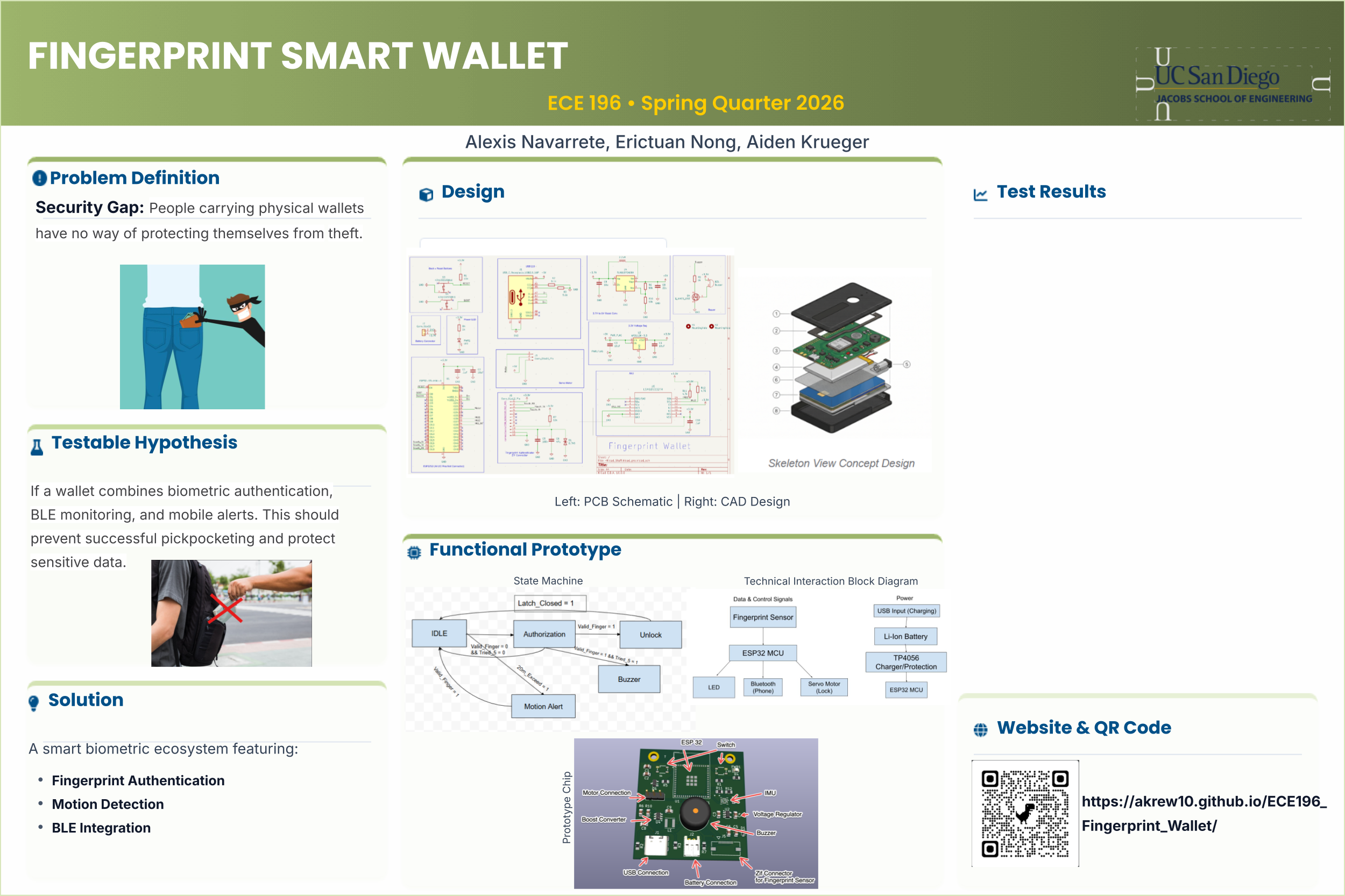
People carrying physical wallets in crowded urban areas face a high risk of pickpocketing.
When thefts happen, victims lose not only their money but also sensitive personal information.
Many of us travel or plan to travel, especially to places like Europe, where pickpocketing is common in tourist areas.
Losing a wallet not only means losing money, but also IDs, cards, and the ability to continue a trip smoothly.
Current solutions don't fully prevent the issue or alert users in real time.
Solution 1
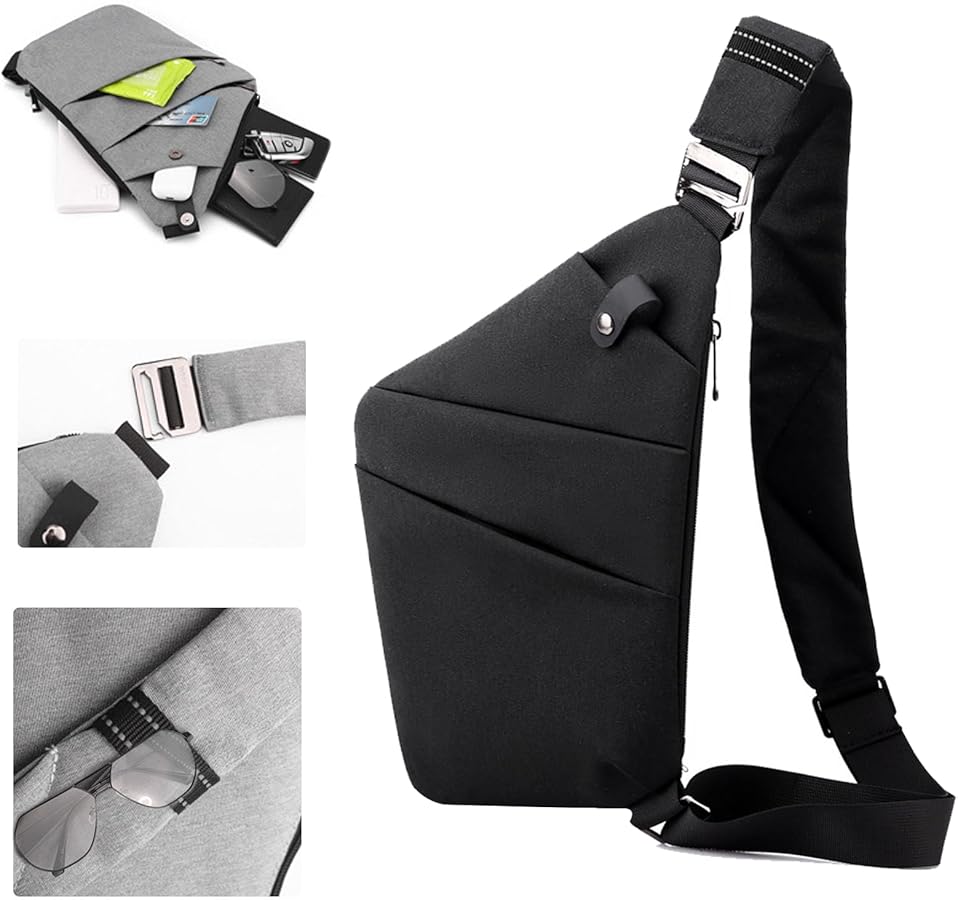
Anti-Theft Bags
- What works well
- Blocks card scanning (RFID protection)
- Hidden zippers / compartments
- Some are Slash-resistant
- What is missing
- Doesn't help recover the item once it's gone
- No real-time alert system
- Can be bulky or less convenient for everyday use
Solution 2
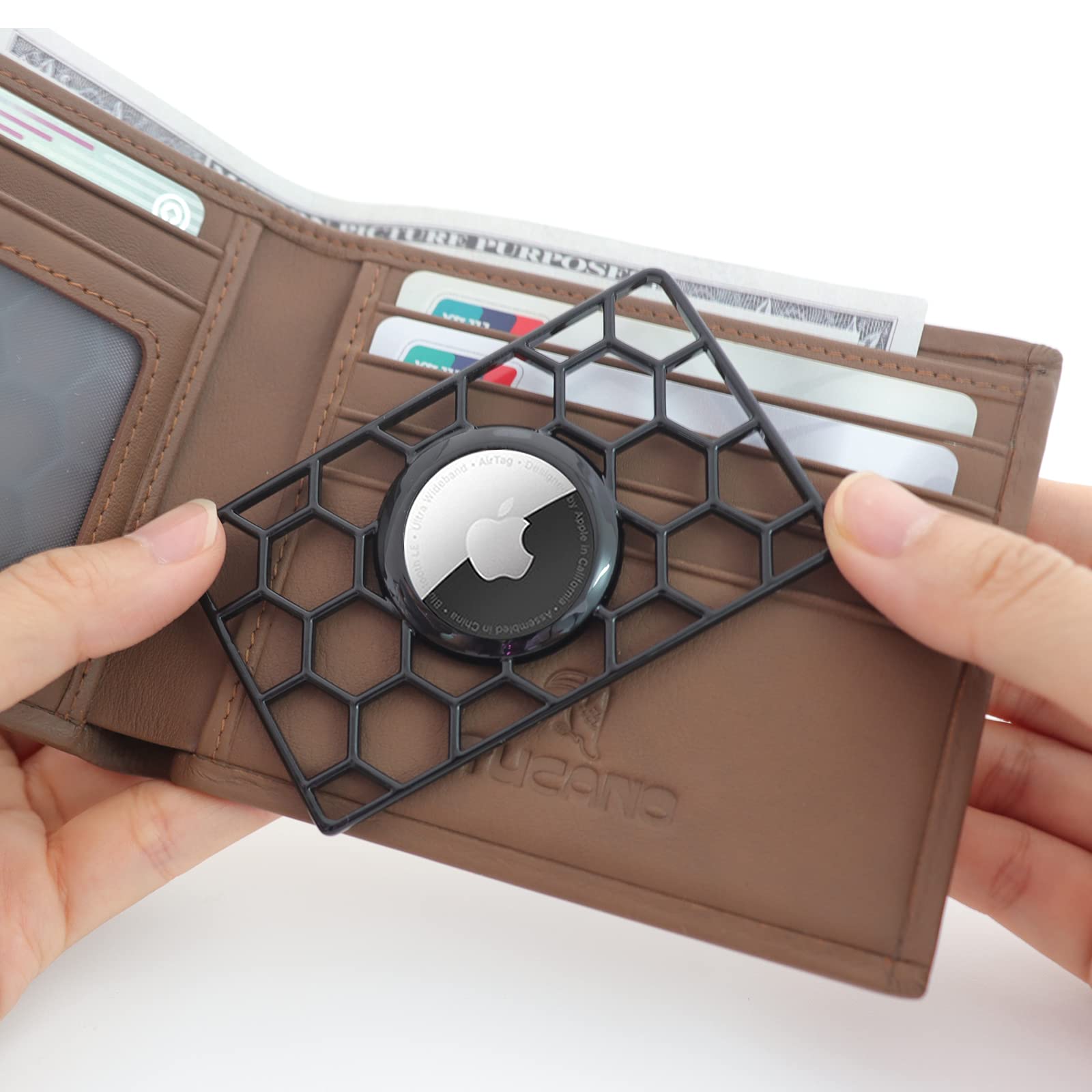
Smart Trackers (Apple AirTag)
- Description of current solution
- Small Bluetooth-enabled tracking device that can be placed inside a wallet
- Uses Apple's Find My network to locate lost or stolen items
- What works well
- Real-time location tracking through a large global network
- Helps recover lost or stolen wallets
- Compact and easy to carry without adding bulk
- Can notify users if they leave their wallet behind
- What is missing
- Does not prevent theft from happening
- Alerts may not trigger immediately during pickpocketing
- Requires Apple ecosystem to function fully
- Tracker can be removed and discarded by the thief
Our Solution
Real-time Wallet Protection
A smart, biometric secured wallet that uses fingerprint authentication, motion detection, and wireless connectivity to prevent theft and protect your belongings in real time.
Testable Hypothesis
If a wallet combines biometric authentication, BLE-based proximity monitoring, and mobile alerts, then it can reduce successful pickpocketing incidents by preventing unauthorized access and notifying the owner immediately when separation occurs.
Quality Sketch / Draft CAD
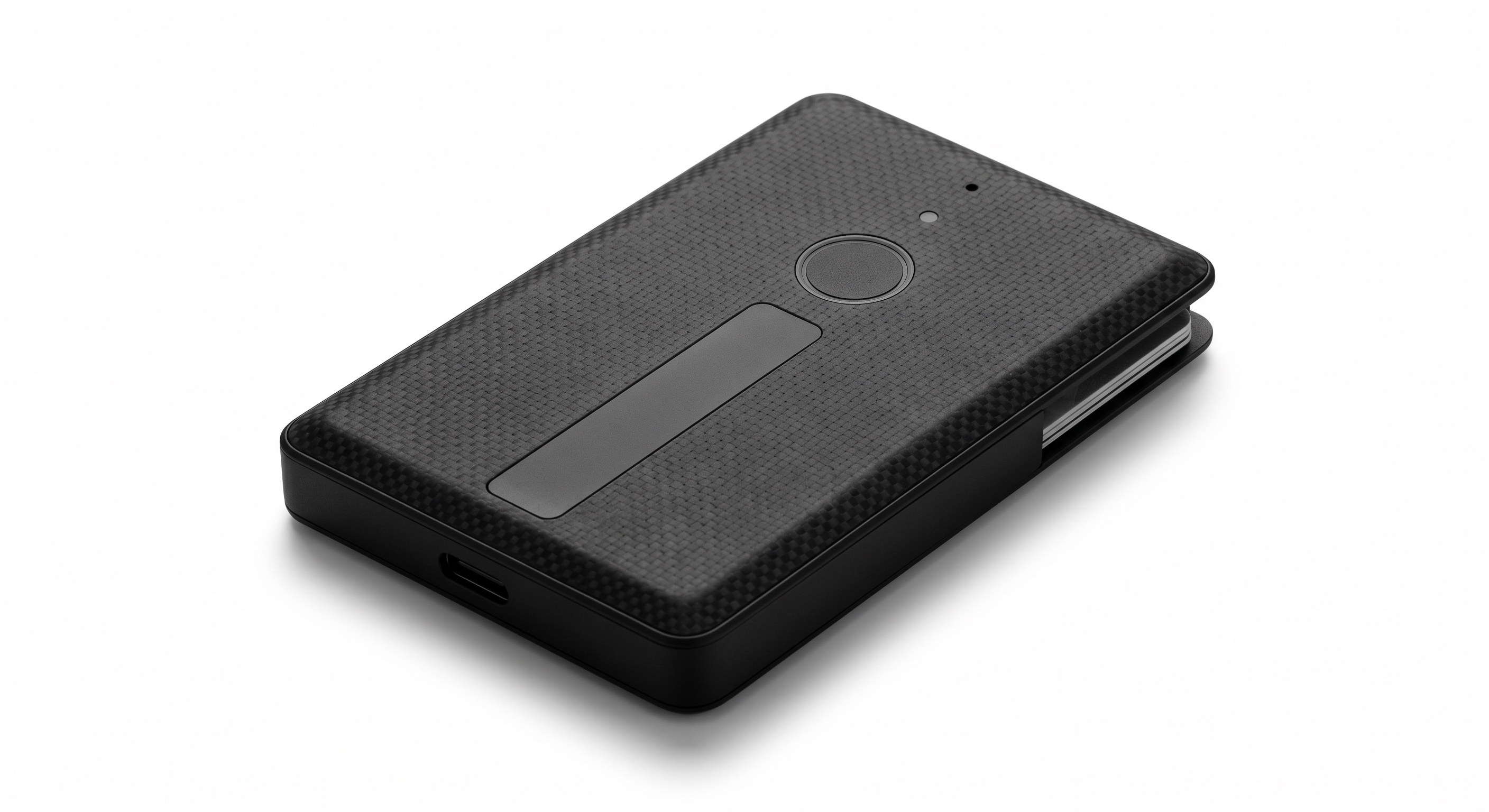
Wallet Concept Design
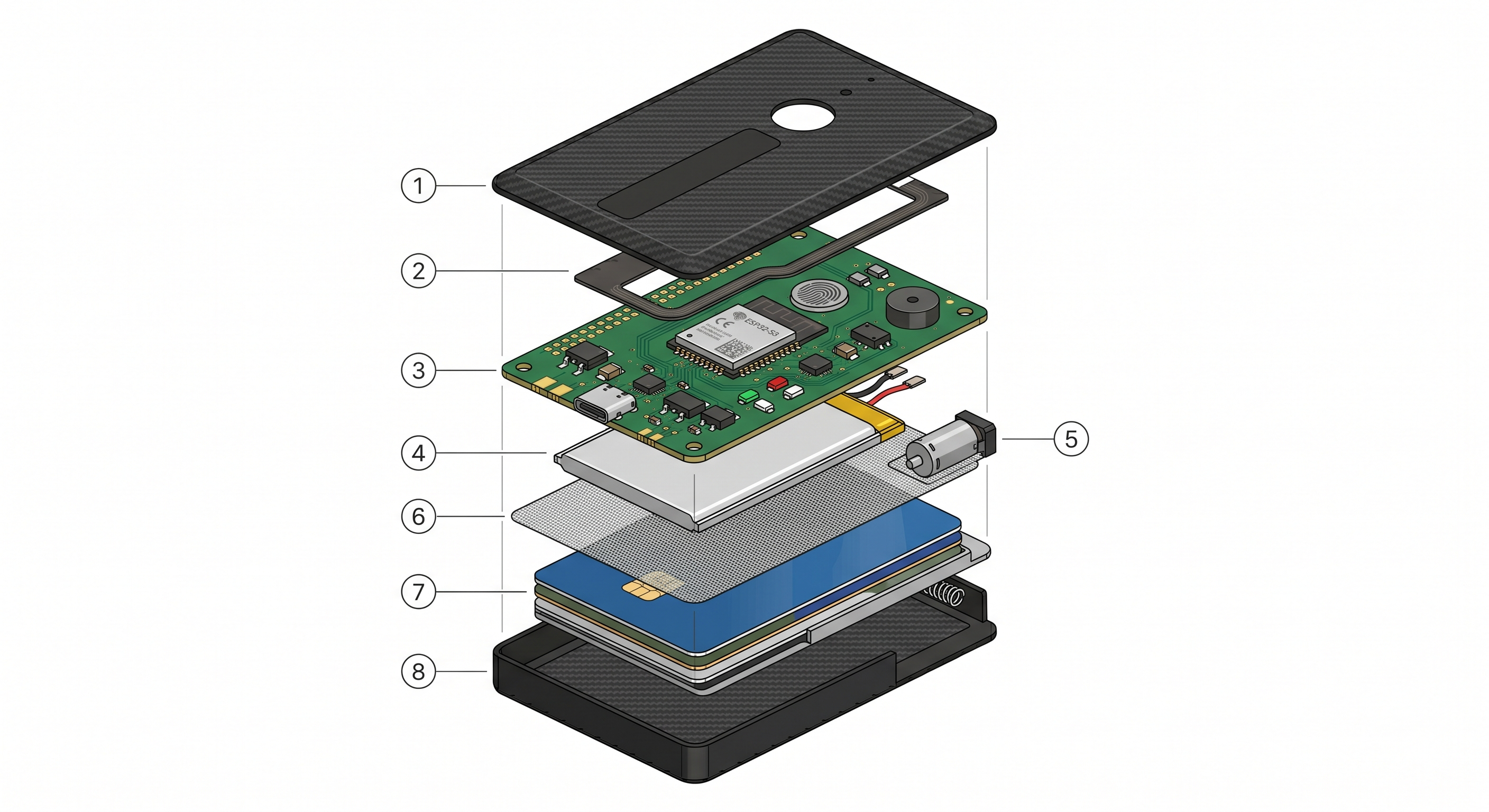
Skeleton View Concept Design
What the Technology Will Do
- Authenticate the owner via fingerprint before allowing the wallet to open
- Detect unauthorized removal from your pocket using motion sensors
- Send real-time alerts to your phone if potential theft is detected
- Block RFID with a built-in shielding mesh
- Provide haptic and audio feedback for user interactions
Technological Aspects of Solution
- Layer 1 — The Face: The top shell features a precisely machined circular cutout for the fingerprint sensor. A small pinhole at the top houses the ambient light sensor, this allows the wallet to "know" it's in your pocket so it doesn't accidentally trigger.
- Layer 2 — The Gesture Strip: Directly beneath the top shell is a capacitive touch module. It's designed to swipe or tap on the surface of the wallet to interact with it.
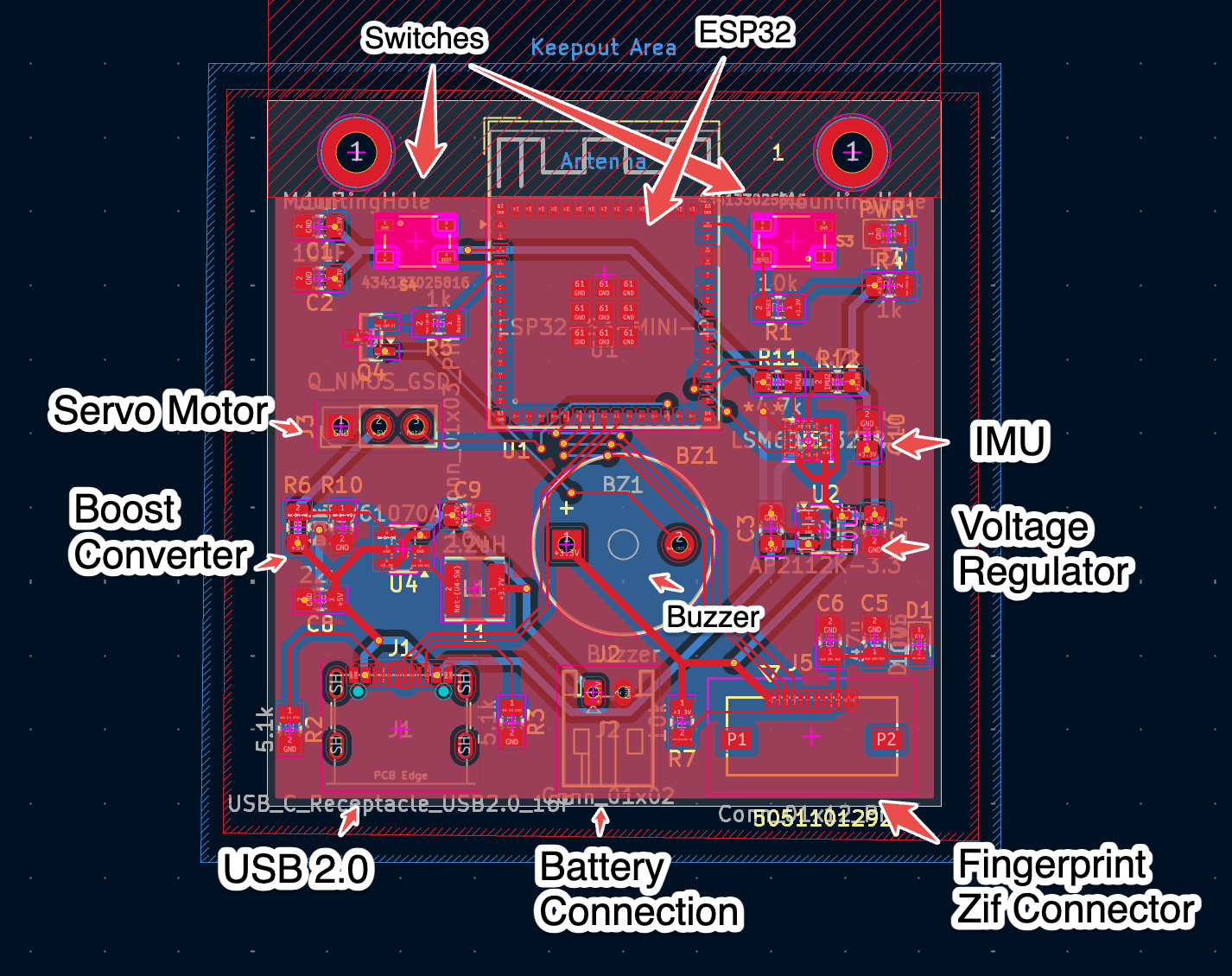
- Layer 3 — The PCB: ESP32-S3 module, biometric sensor, power and connectivity management, audio feedback, motion sensors, LED indicators.
- Layer 4 — The Battery: A rechargeable lithium battery.
- Layer 5 — The Motor: A micro stepper motor positioned next to the battery, responsible for the card ejection mechanism.
- Layer 6 — RFID Mesh: A layer that blocks contactless card skimming, protecting your cards from unauthorized RFID readers.
- Layer 7 — The Card Stack: The compartment that holds your physical cards, secured behind all the protective layers above.
- Layer 8 — The Chassis: The bottom shell that holds everything together.
Parts List
- Microcontroller (ESP32 or similar with BLE support)
- Fingerprint sensor module
- Buzzer and/or vibration motor
- Battery and charging circuit
- Optional motion/proximity sensors
- Wallet chassis materials and fasteners
Block Diagram of Technology
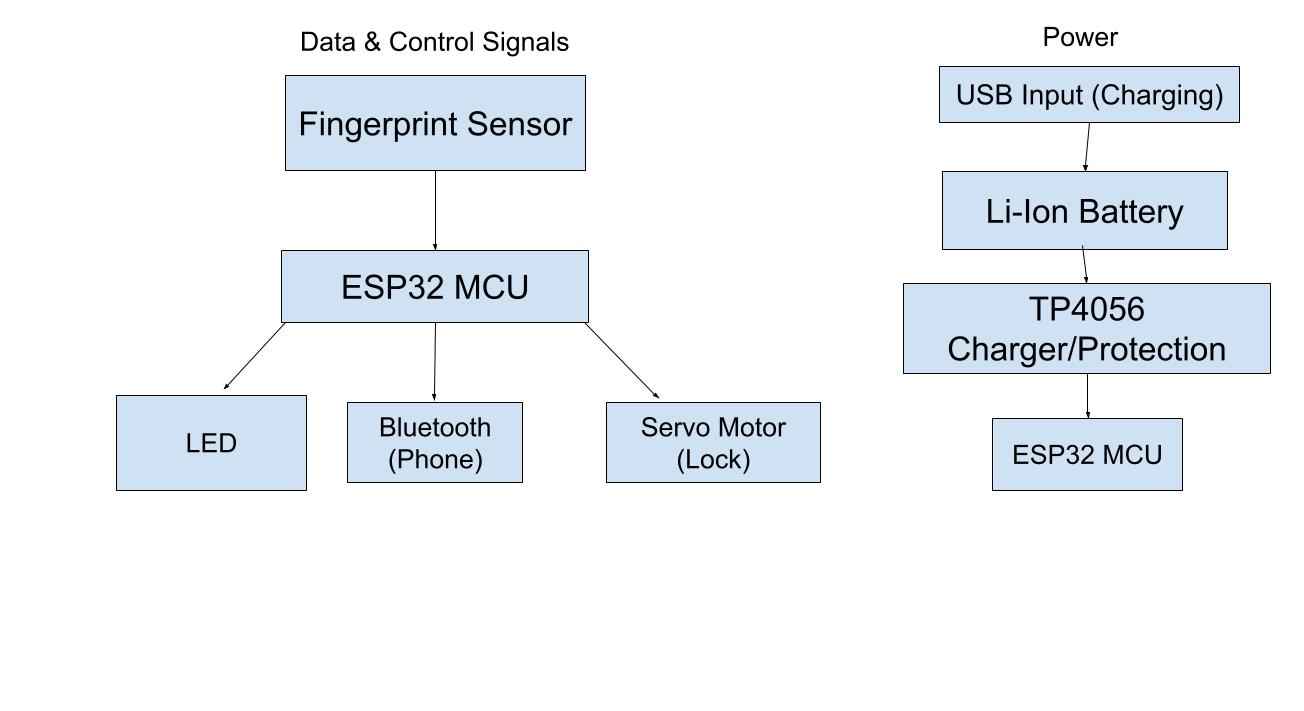
Overall system block diagram showing ESP32-S3 microcontroller, sensors, actuators, power, and mobile app connectivity
Milestones
Milestone 1 (Week 7: May 11–17): Parts Arrival, Hardware Bring-Up, and Sensor Validation
Goal: Receive components, validate hardware, and establish baseline functionality.
- Receive and inventory all ordered components (ESP32-S3, fingerprint sensor, IMU, LiPo battery, boost converter, buzzer, LEDs)
- Assemble and test individual modules on breadboard/prototype setup
- Verify ESP32-S3 power system (3.7V LiPo + boost converter + 3.3V regulation)
- Establish UART communication with fingerprint sensor
- Verify IMU/accelerometer motion detection over I2C
- Output: Core hardware components successfully communicate and function independently
Milestone 2 (Week 8: May 18–24): Security Logic and Anti-Theft Detection
Goal: Integrate authentication and theft-detection systems.
- Enroll and verify authorized fingerprint templates
- Implement owner-verification logic for secure wallet access
- Use IMU/accelerometer to detect suspicious movement or wallet displacement
- Trigger buzzer/LED alert for unauthorized movement
- Establish BLE communication between wallet and phone
- Output: Wallet verifies owner identity and detects potential theft events
Milestone 3 (Week 9: May 25–31): Full System Integration and PCB Prototype
Goal: Transition from prototype to integrated final system.
- Finalize PCB schematic and layout
- Integrate fingerprint sensor, IMU, BLE, and alert systems into one hardware platform
- Implement battery charging and power management system
- Test complete system reliability under real-world wallet scenarios
- Begin enclosure/wallet form-factor assembly
- Output: Fully integrated smart anti-theft wallet prototype
Milestone 4 (Week 10: June 1–7): Final Demo, Optimization, and Presentation
Goal: Polish project for submission and demonstration.
- Optimize BLE alerts and fingerprint response time
- Finalize enclosure and presentation visuals
- Perform full end-to-end testing
- Demonstrate fingerprint authentication, theft detection, and phone connectivity
- Prepare final website, documentation, and project presentation
- Output: Final working smart anti-theft wallet ready for grading
Figure of Timeline
| Week / Date |
Milestone |
| Week 7 (May 11–17, 2026) |
Parts received; ESP32-S3, fingerprint sensor, IMU, and power systems individually tested and validated |
| Week 8 (May 18–24, 2026) |
Fingerprint authentication and IMU-based theft detection integrated with buzzer/LED alerts |
| Week 8–9 (May 18–31, 2026) |
BLE phone communication established for proximity monitoring and anti-theft notifications |
| Week 9 (May 25–31, 2026) |
PCB finalized and full smart wallet hardware integrated into prototype enclosure |
| Week 10 (June 1–7, 2026) |
Final end-to-end demo: fingerprint verification, theft detection, BLE alerting, and complete project presentation |
PCB
PCB Schematic
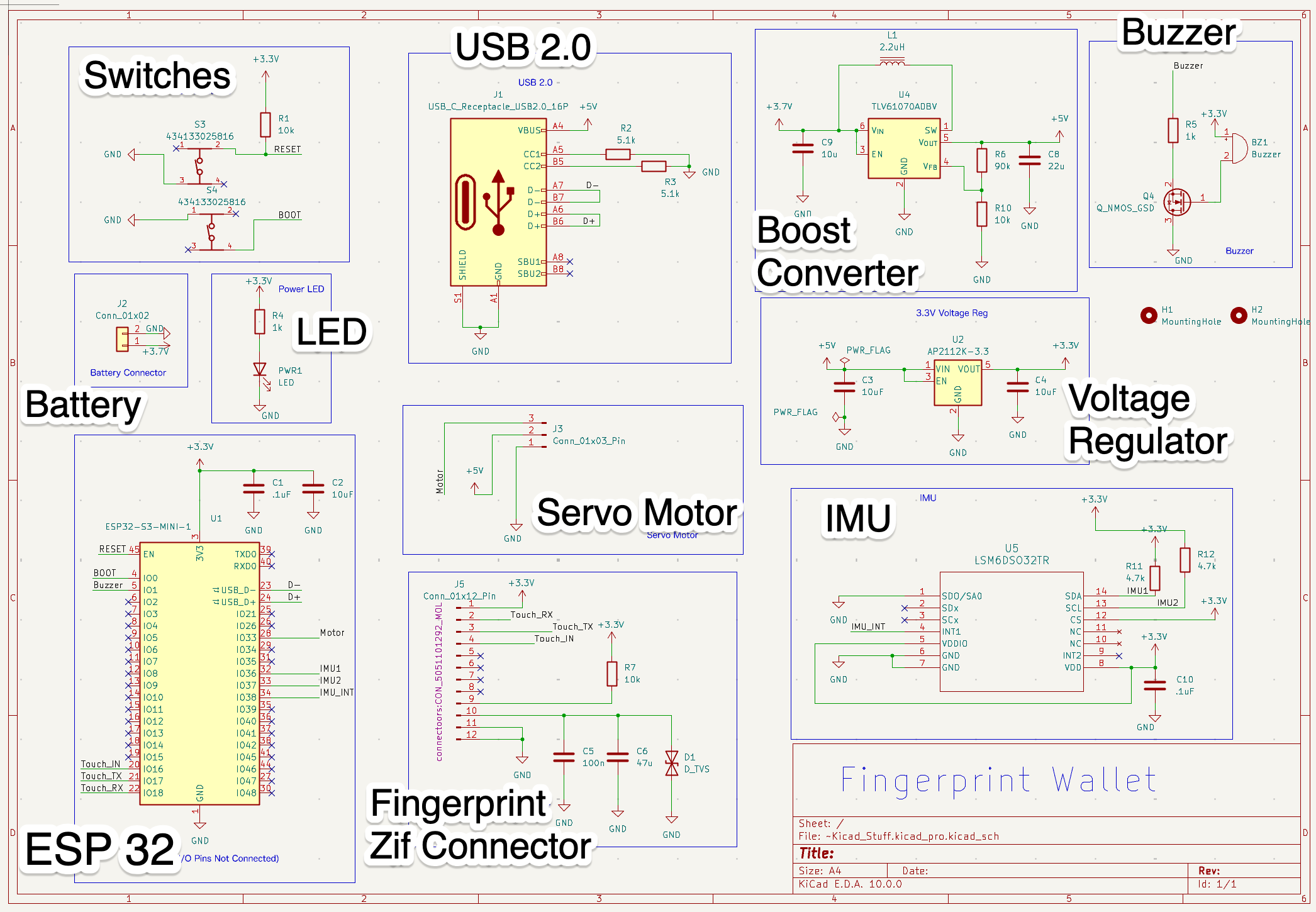
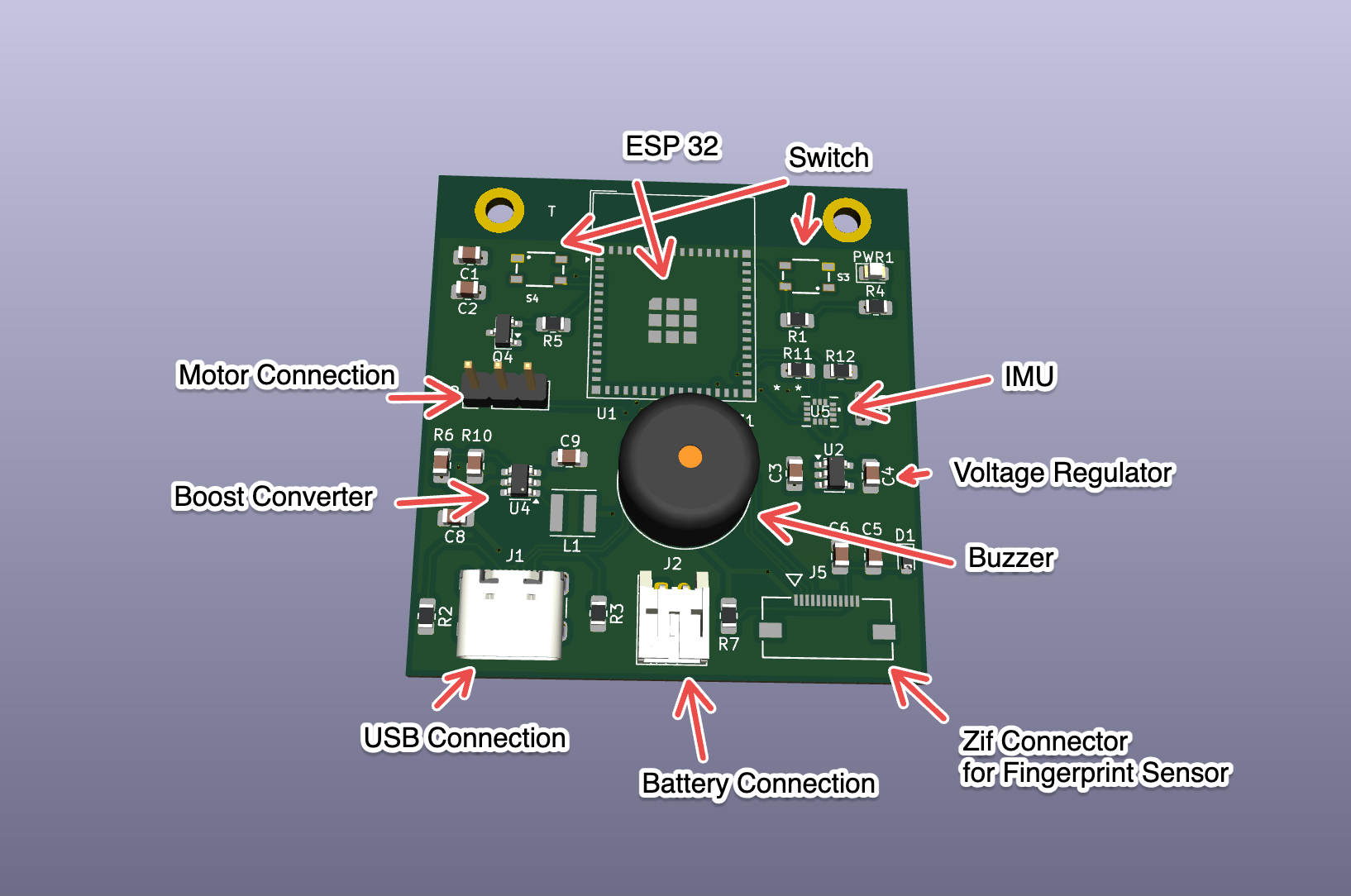
PCB Design
3D Viewer